
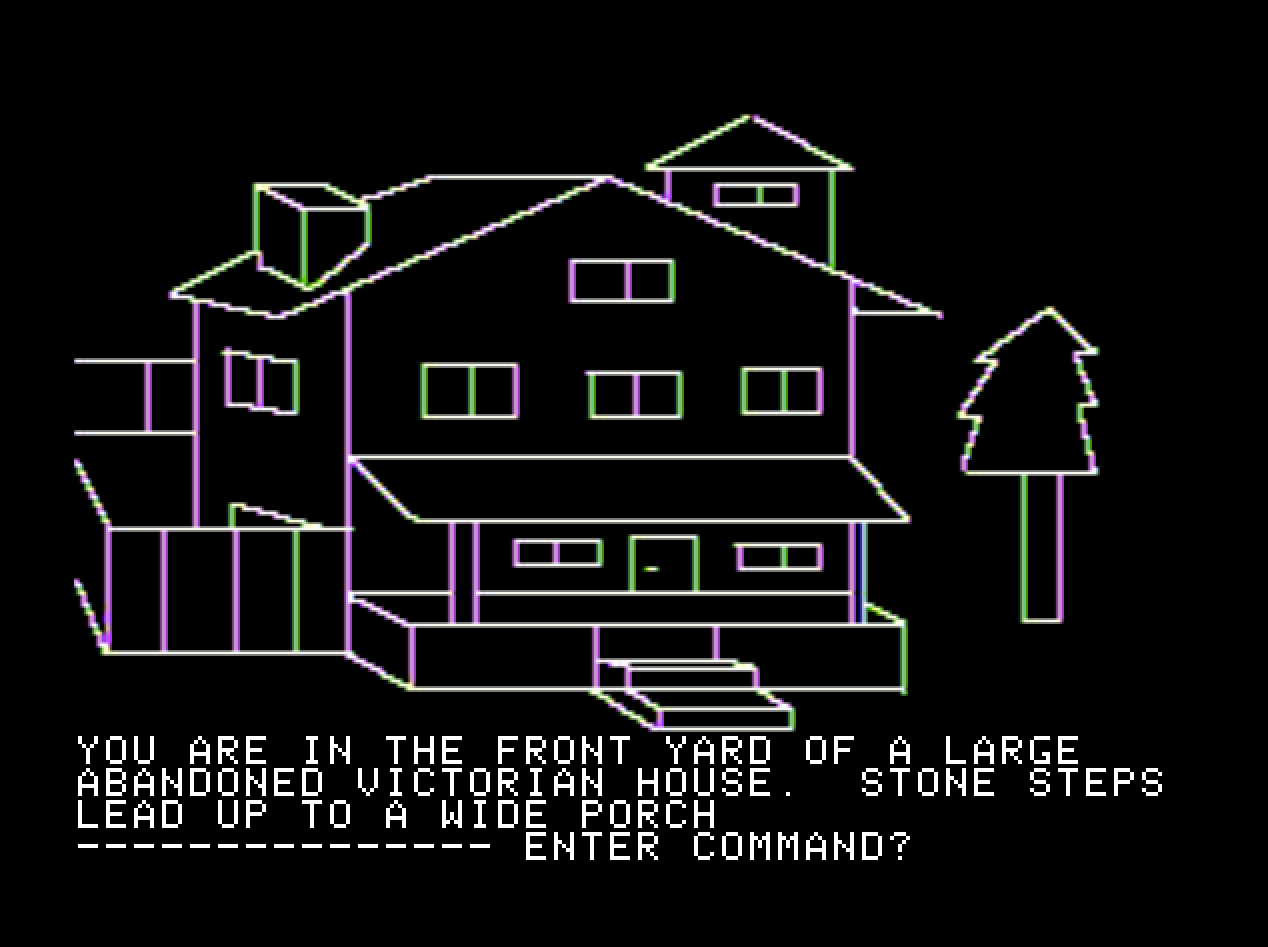
Created in 1980 by Sierra, at this point going by the name On-Line Systems, Mystery House is widely considered to be the first graphic adventure game ever created. I can’t say for sure whether that is true or not, but it’s fair to say it sits at an important juncture at birthplace of the graphic adventure genre. It might be the game, but it is the game.
Mystery House takes the parser-based conventions of text adventures, but uses the majority of the screen real-estate to present pictures of the particular screen you’re in. The intention, I think, was to increase immersion and accessibility in a more narrative focused genre, rather than the more abstract notions of other video game genres.
It was the first game in the Hi-Res adventure game series ( branding that has not aged particularly well), and so feels like a suitable point to start this adventure game journey.
Before diving into the game proper, the in-game instructions provides a short breakdown of the plot, and presents a list of people in the house:
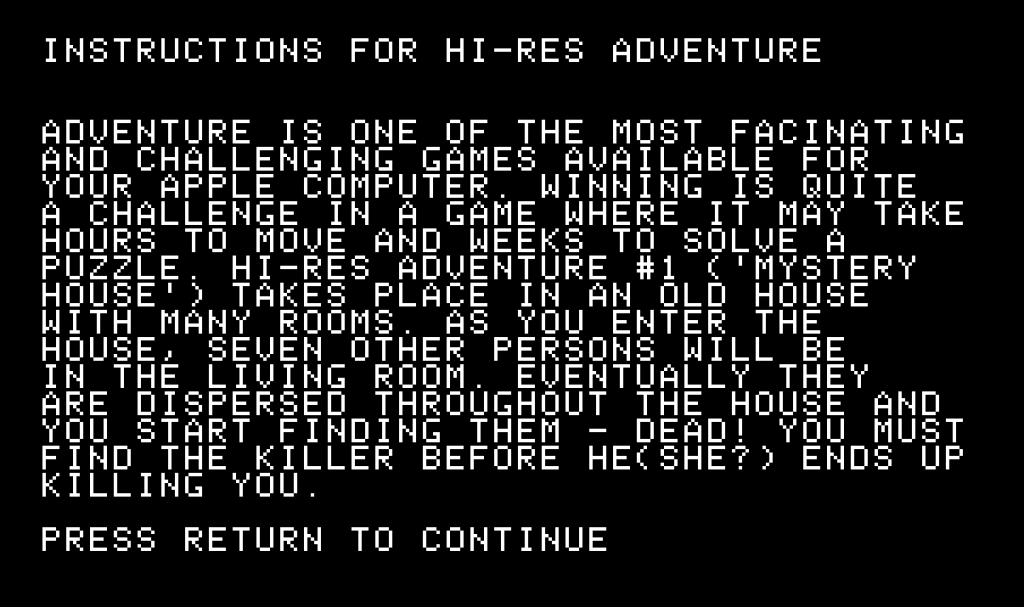
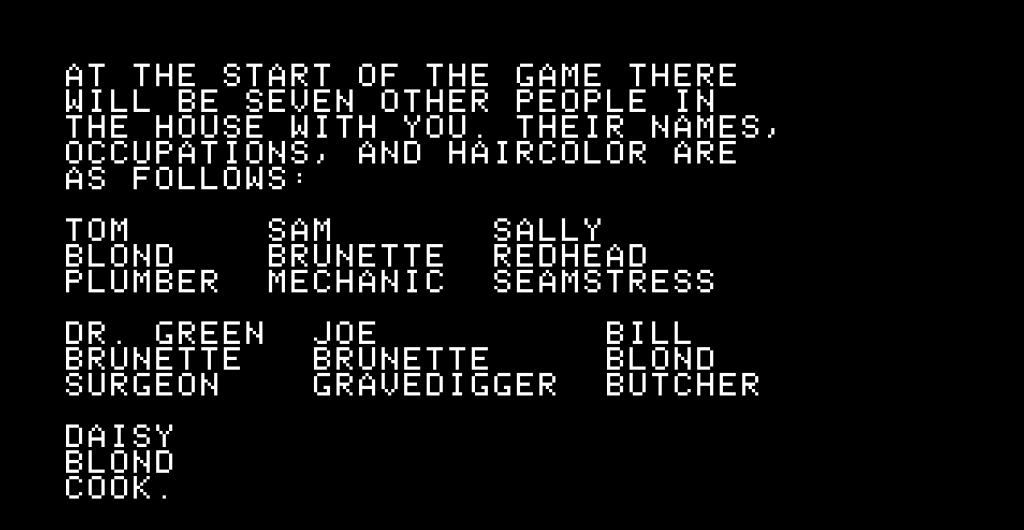
We get all the vital info; names, hair colour and occupations. Dr. Green is apparently not willing to divulge their first name, which is immediately cause for suspicion and class warfare. The other people are decidely blue-collar, so this creates an immediate tension. We’re given no explanation given as to why we’re all in the house on this fated night – so I’m going to go with the usual mysterious ‘summons via letter with promise of your heart’s desire’, etc.
As a slight aside, the instruction manual does refer to these people as your ‘friends’. The little story the game contains kind of falls apart if they are actually people we know and like. So I’m going to ignore that, and work on the basis that we’re all meeting for the first time.
It’s a little unusual to frontload your story with plot-related information about what is to come; but I’m guessing the reason for doing was that Sierra didn’t feel fully confident that the game presented this clearly. I don’t actually think it was necesary – I found what is going is fairly self-evident, but I think they really wanted to paint the picture, and as it’s one of the first one of these things, and I can’t speak to the mindset of that particular moment in time, I guess it felt necessary then.
Playing the game
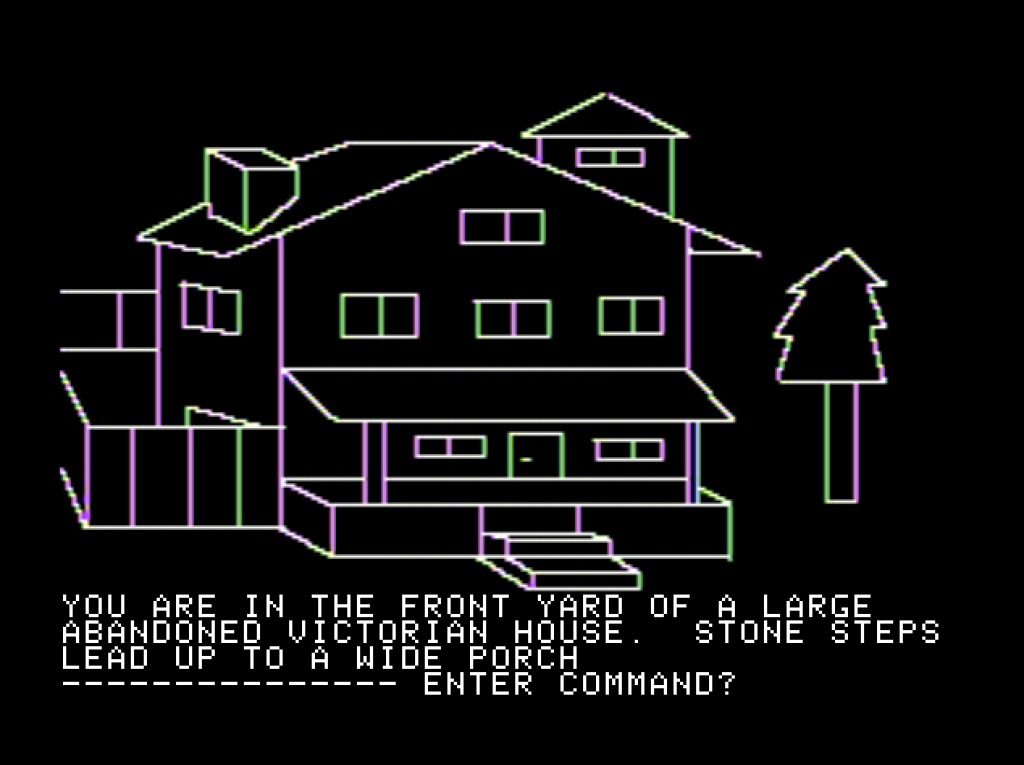
We start out front of said house of mysery, with a few lines of description and our parser blinking expectantly. This wireframe-eqsue image is the iconic Mystery House visual, and despite being close to fifty years on from its release, this graphic still holds a kind of allure. There is a moody, foreboding tone to the scene, the black and white is striking and offsets some of the flaws of the actual artwork itself, like the wonky tree and odd perspective. It adds to the initial feeling of unease, and the game does a lot of good tone-setting up front with these limited visuals. Unfortunately the later graphics don’t really live up to this one, but there is at least a vaguely unsettling vibe throughout which works to its benefit.
The first thing to do is to get into the house itself, and start to get to grip with the parser. It’s a two word system, very simple and with very limited input. I was expecting more descriptive text for scenes and items, and was surprised how little there actually is throughout. I believe this is intentional, as I suspect they wanted their graphics to do the talking, and to further differentiate from the more verbose text adventures with a specific philosophy of simplification and user-friendliness. And look, I get that attributing user-friendliness to this game, or Sierra as a whole, might sound insane to anyone familiar with their particular oeuvre of masochism, but I do think that was the idea that was being sold with this genre – I think Roberta Williams saw the potential in taking a parlor mystery and letting players live through an interactive version of that, and wanted it to have a degree of mainstream appeal. So less reading, more pictures, simpler interactions and puzzles (again, compared to text adventures).
With that in mind, I found it curious that the first command that you’re suppose to do in this game, to get to the door and into the house, is Up, rather than to use one of the cardinal directions, for example, North, to walk onto the porch. This is the first ever adventure game, after all. This scene is the Mario 1-1 of the genre. I want to warm up a bit, stretch my legs, before I start sprinting. Give me some N, S, E,W action. Now, it’s not like there aren’t clues – the text description does say there are stone steps leading up – but I will admit that this first action did throw me for an alarming number of failed prompts before I tried it. I don’t think there’s anything wrong with it, but I’d suggest that making north work would probably have been okay too. Those steps don’t look like they contain the sheer verticality required for me to consider myself moving upwards, but they are steps. Thankfully, I managed the next bit with gusto. Open Door. Go Door. I’m learning you, parser. Be patient with me.
The door slams shut behind us and somehow, also locks itself. If you try it later, when you have the means to unlock it, the door will continue to relock itself when you pass through. So this door is mechanically inclined to lock on closing. Since the other seven people are already in the house and I’m assuming came through the same door, I’m surprised the door isn’t already locked, but it isn’t. So this front door opens freely from the outside and locks from the inside, requiring a key to leave. This is the opposite of how front doors normally work, so I’m going to assume that it was installed the wrong way round.
In the hall, we come face to face with our friends/strangers:
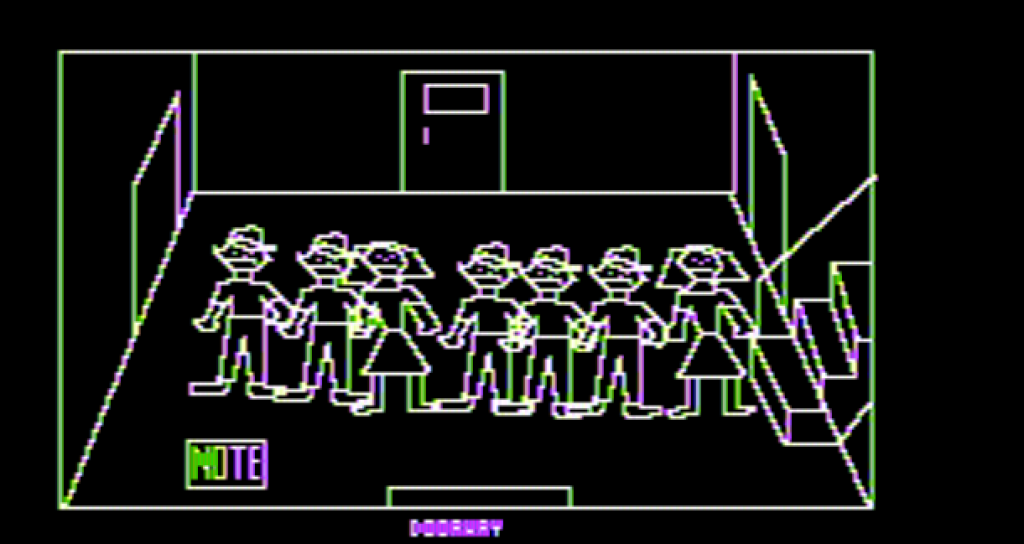
Look at them all, just standing there in a line. You can’t talk to them, interact with them, or even really look at them. If you Look People, the parser tells you rather snottily that they’ve already been explained about in the instructions.
There’s a note. You can tell because it says NOTE on it. The note provides some context for being here:
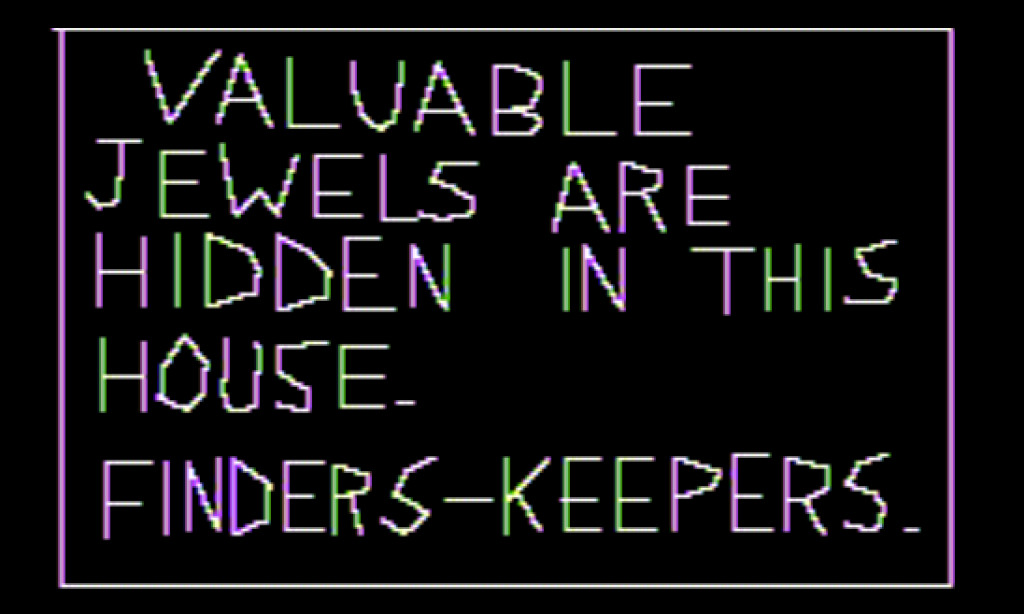
So we want valuable jewels. How valuable, I have no idea, but they must be pretty good, based on the resulting frenzy that immediately follows leaving this hallway. This is why the friends thing doesn’t really work – I cannot imagine reading this letter and immediately watching my buddies go nutso over some jewels. I’m not even 100% sure it works as strangers. We clearly all have steady income through our careers, that’s one of the three things we know about everyone here. But regardless, once you leave this room and come back, everyone has scattered, desperate to solve the main win condition of the game – find the precious jewels.
From this point you are given free reign to explore. The ground floor of the house isn’t too big and also not too confusing from a mapping perspective. There are a few confusing rooms where the orientation doesn’t match the cardinal directions, but most make sense.
The first major puzzle to deal with is a timer-based sequence which starts after a little bit of exploring. A message appears informing you that it’s starting to get dark, and continues to do so for around 16 actions or so before the night settles in… plunging you into darkness.
To my surprise this doesn’t result in an immediate game over. Instead you get no picture and no items are listed in the room desciptions but that’s about it, as far I as could tell. It’s a pain, but you can make some progress with it if you know where things are. In a way, it actually kind of works as a decent facsimile of floudering around in the dark. The aim though, is to get hold of some light. There is a candle in the dining room, and some matches can be found in the kitchen cabinet. As puzzles go, it’s not too tricky… except that when you do light the candle, you drop it like a clutz and inadvertantly start a fire on the dining room carpet.
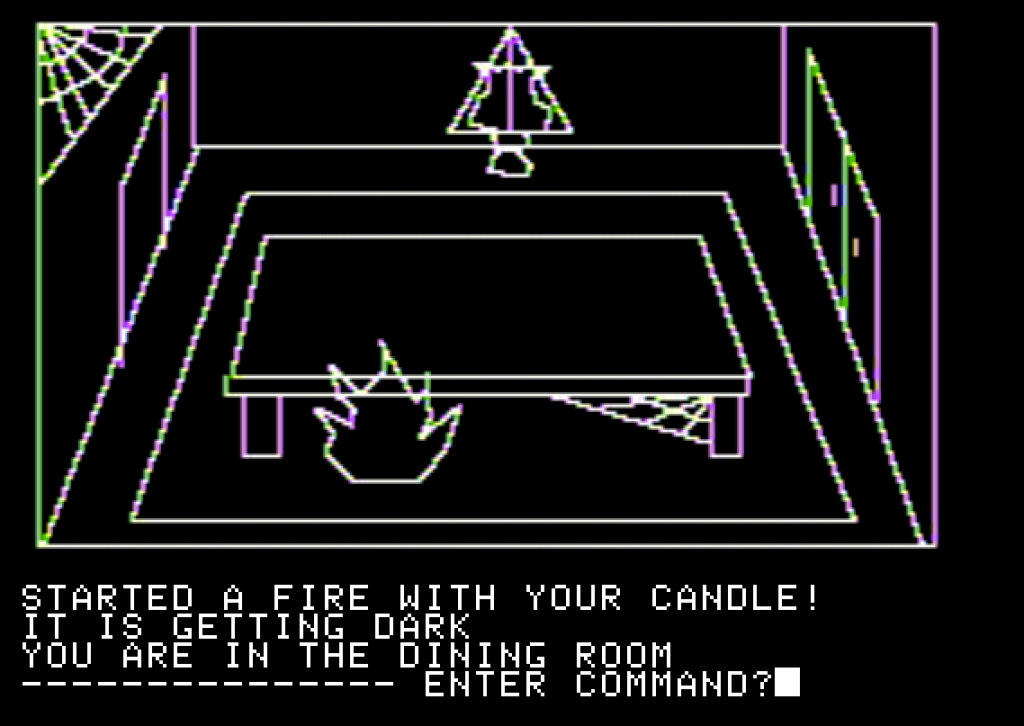
This fire is likely to be your first death if you haven’t thought to also collect the pitcher from the refrigerator in the kitchen, and figured out how to fill it with water. This part of the sequence is the most obtuse, there is no in-game mention of the tap as a working feature, or that you need water. The aquistion of the pitcher can be considered a semantic clue as you may figure you need to fill it with something, and then having experienced the fire is likely to lead you to the thought that having a pitcher of water is the likely solution. So how to turn on the sink. Turn Tap? Run Tap? Use Tap? Same again with Sink? Nope, none of those. Faucet, in case of Americanisms? Nope. The correct answer is Water On. I actually found Tap On worked as well – so it seems like On is a vital component to the logic. After that you need Get Water, which is a little better, but not much.
I think when they made they game they knew ‘Water On’ was a big pile of poo because they actually use it as an example in the instructions. I honestly think that is the only way to legitimately stumble upon the right wording. Once you have your full pitcher of water you can pour it onto the fire and continue on your way incineration-free. As a nice little side-bonus, the fire has bored a hole through the floorboard and revealed a small key. What a lucky vital-to-progress find!
Exploration of the rest of the house starts to reveal some shocking events are taking place off screen. My first encounter with one of these was when walking into the back garden.
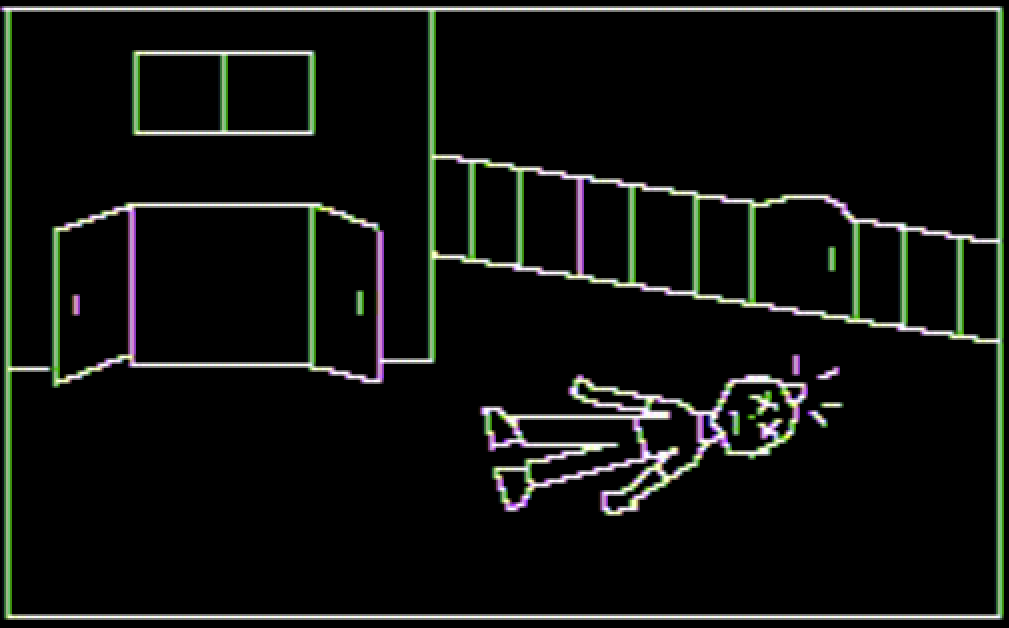
Someone’s only gone and been murdered. It’s er… Sam the mechanic, who has been bonked on the head. It doesn’t take too long to uncover a potential suspect.
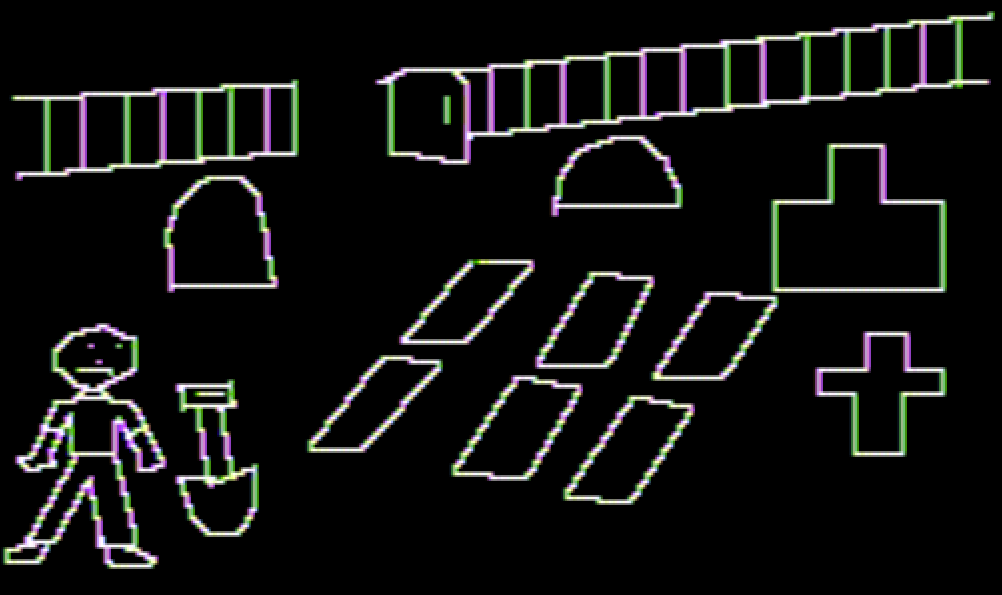
Just through the gate is Joe the grave digger. He’s on a bit of a busman’s holiday here, digging some graves. Wait, Joe – why are you digging graves, buddy? I don’t suppose you saw Sam just back there – he looks like he was hit by a shovel or something. Unfortunately, you can’t really discuss any of this with Joe, and the only thing he’ll do if you go near his graves is bury you alive, so best just leave him to it for now.
More bodies are to be discovered upstairs. Poor Dr. Green has been stabbed in the nursery and across the way Sally Seamstress has also been whacked on the head. She has a mysterious blonde hair on her corpse. Consulting our notes, Tom, Bill and Daisy are all blonde. They’re also the only ones not currently accounted for, which is typical. Walking into the master bedroom results in someone throwing a knife at you while your back is turned. They miss, and you get to keep the knife as a reward.
There are a couple of important rooms up here to finish off the main areas of the house. The attic contains a hammer, and a side room which has an enticing chest in it. If you remember grabbing
Leave a Reply
You must be logged in to post a comment.